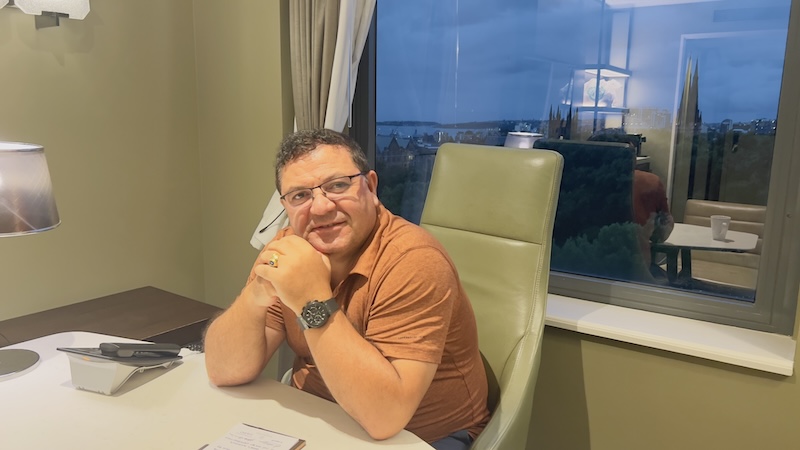
My trip to Kurdistan was more than the ordinary trip. This was my second trip, but this one was beyond what I imagined. I am still having a hard time processing what I have witnessed and what I learned first hand Kurds have escaped from. When my flight took off just after midnight from Istanbul, Turkey, I was eager and expectant. I fully expected this trip to have great import to me. My excitement continued for the entire flight, two and half hours from Istanbul to Erbil, the capital of southern Kurdistan. As I was approaching Kurdistan (Northern Iraq), flying over the stunning mountains and valleys, the fertile land of Mesopotamian, and the cradle of civilization, I thought about the Kurdish people trying to move on in their lives after all the massacres in their homeland. The Kurds are doing well now and will be even greater in the future, but, nevertheless, I was expecting a third world of dirty, dusty mud roads when I arrived, but was amazed to see a thriving, clean and modern city in Erbil. The Kurds are trying to make Erbil a second Dubai or even better.
After a couple hours of sleep, I met friends and spent the next few hours discussing logistics. We visited some of the Christian refugees who had escaped from the ISIS, temporarily settling in the city, and my friends and I listened to some of their horrific stories of how they escaped from the ISIS. A day later we headed off to Dohuk, driving through the magnificent countryside and through miles of oil fields approaching the city of Mosul, which is under the control of the ISIS. As we traveled to the city of Dohuk, the ISIS was fighting with the Kurdish army, known for its ferocity and for its fighters’ named peshemera, meaning “those who face death.”
Instead of encountering hostile guards and hardened survivors, I experienced calm, polite, professional Kurdish police at the checkpoints. I was also shocked, as I was not expecting that people would be very friendly or hospitable, especially toward foreigners, but this trait had not stopped neighboring Muslim countries from oppressing them for centuries.
We went to visit some of the Yezidi Kurdish refugee camps in Dohuk, where displaced people had escaped from the ISIS from Shengal and Maxmur running to the mountains to save their lives. As I listened to the stories of the refugees who had escaped, I learned that it was mostly children and women who had traveled for more than twelve hours to the Syrian border then were brought to the city of Dohok. Those refugees said the PKK Kurdish guerilla fighters had saved them and had ushered them to safety. The PKK looked after them, and escorted them to Dohuk or Erbil, cities within the protections of the Kurdish Regional military. The refugees considered the PKK their true heroes, because they saved their lives along with the lives of thousands of other women, children, and men. Because they did not have anything to eat, they had to eat roots to survive. The understood that “if you don’t run, you will die, you will be raped, or you will be sold if you are a women especially a young girl, so that you will wish you had have died.”
As I was listening to their stories, I was ashamed to call myself a human because another human had committed these atrocities to these people just because they do not believe what they do. One man said that by the time the American military came to save them, it was already too late, because hundreds of the children had already died from dehydration on the way to the mountains; some of the girls had been kidnapped and sold into slavery; and several woman had killed themselves to save their dignity instead of being treated by the ISIS in such an inhuman way.
The ISIS has traumatized those people lives, destroying their homes and villages. Once again the Kurds were devastated. I asked one of the refugees if this is first time they have faced this kind of atrocity. He replied, “No, this is not first time, Saddam had done it before, and now they have done it again led by Saddam’s ex-commanders using the same tactics.” Those people have lost their dignity and self esteem. It is the job of humanity to help these people to regain their ordinary lives again. Some of the refugees live in the schools, in rented houses, or in unfinished buildings, while some stay in tents. During my interview with the people, I discovered more about the atrocities perpetrated by the ISIS against them. According to some Christian refugees, there are no longer any Christians left in Mosul. The Kurdish region, however, has welcomed all these internally displaced people, the IDPs. It has done whatever possible to assist them; it is estimated that nearly two million IDPs are living in the Kurdish region at the moment.
Once again I saw the United Nations as a completely useless political club with luxury cars, inflexible rules, and a big logo to protect states’ interests, but not the civilians. I also asked one man about who supported the ISIS? He replied Saudi Arabia, Turkey, Qatar, U.S., Israel, and ex-Saddam loyalists, because if they did not support the ISIS, it would not last long.
I have seen Yezidi Kurds in refugee camps made of tents surviving in the cold rain and mud. I have seen many children without shoes, schools or even sufficient food. I do not know what is going to happen to them. Many mothers and fathers were looking at each other while sitting outside the tents, staring at us and with their eyes asking us what is going to happen to them.
Yezidi Kurds have suffered lots of awful experiences of attacks from Muslim neighbors throughout the centuries. After WWI and the collapse of the Ottoman Empire, France and the United Kingdom redesigned the map of the Middle East disregarding ethnic, religious, and cultural factors in drawing states such as Syria, Iraq, Turkey, and Jordan but failing to create a Kurdish state that is homeland for more than 35 million Kurdish people.
The Kurds are nation without a state, if by nation I mean a people who are ethnically distinct and who have written for themselves a history of political and military struggle to establish an independent state. The Kurds are the largest ethnic group in the world who occupy a compact geographical area but without a nation state of their own. The Kurds are the native people of Mesopotamia and have always lived in that region. The majority of the Kurds, that is more than 15 million, live in Turkey, and more than 7 million live in Northern Iraq, with 2 million living in Syria, more than 3 to 4 million living in Iran, and 800 thousand having emigrated to Europe particularly in Germany, Sweden, and some of the post-Soviet countries. The Kurds trace their origins back more than 2000 or 3000 thousands years to the Medes of Ancient Persia. Under the Ottoman Empire the Kurds were semi autonomous, but after WWI, the Allies denied the Kurds their homeland, and instead divided their land and their people.
Only the Iraqi Kurds have an autonomous region in the Kurdish territory of Iraq. Iraqi Kurdistan is a self-governing region with its own president, military, and police. Under the Iraqi government’s constitution the Kurds are allowed to have their own military and peshmerga, so that the Kurdistan military have made the Kurdish region a safe place to visit. The majority of Kurds are comprised of the Sunni branch of Islam and have the misfortune of being oppressed because they occupy the same land as the four aggressive Muslims countries, Iran, Turkey, Syria, and Iraq. Competing regional power struggles, Kurdish control of rich resources such as oil and water, nationalism and international politics have prevented the Kurds from having their self-determination. Those four regimes alike have sought to subjugate the Kurds for own their national interests and to regain access to economic resources and to build administrative hegemony. The approach of both Europe and the United States to the Kurdish issue in the region results from their national interests and double standards. They ignored their plight when Saddam committed genocide against the Kurds in 1988, because at the time they had a good relation with Saddam. When these relations ended, Western countries and the United States called Iraqi Kurds “good Kurds,” labeling the other Kurds as “the bad Kurds.” The Kurds who fought against Saddam were good Kurds, but the Kurds who fought against Turkey became bad Kurds and were listed as terrorists.
The mountains have been the Kurds’ best friend; the mountains are where the ancient Kurds fled Babylonian hegemony and where the guerillas of the Kurdish workers Party (PKK) fight the Turkish government. The PIJAK guerrillas in Iran are fighting against the Iran regime, the PYD in Syria are fighting against the Assad regime, and the peshmerga are fighting against the Iraqi regime. All four countries oppose the bid for the Kurds to have their own independence. The creation of the ISIS gave the Kurds both opportunities as well as a new risk. The ISIS took over Iraq’s second largest city, and the Iraqi army fled places such as the oil rich Kirkuk, claimed by both the Iraqi central government and the Kurds. The Kurdish region has vast reserves of oil. After the ISIS took over Mosul and the military of Iraqi’s central government collapsed, President Barzani asked the Kurdish Regional parliament for a referendum for independence.
As the rest of Iraq disintegrates into chaos and implodes, only the Kurdish region is peaceful. It is the only place that has sympathy for Americans and America, especially because of the No Fly Zone created by Former President George H.W. Bush following the Persian Gulf War I. That protection saved lots of Kurdish people and made the Kurds the only friend of America in the region. The Kurds asked the US to establish a large permanent US Army military base near the Kurdish capital of Erbil. America chose not to have one. Kurds requested small arms, night vision goggles, and armored vests, in order to fight and defeat the ISIS. The United States, however, turned them down. America wants all the arms to go via Iraqi’s central government. But the still Obama administration definitely holds the wrong foreign policy regarding the Kurds in northern Iraq; it calls for one Iraq and warns companies about buying Kurdish oil. America wants the Kurds to fight against the ISIS and at the same time not to ask for independence. America believes that if the Kurds get their independence, that the more than a decade of America’s investing in nation-building in Iraq will collapse, but America fails to see that Iraq and Syria are failed states, and that the Kurds for decades have wanted to have their own laws, government, and country. My take away message from my trip to Kurdistan is that it is time for the United States and other countries to help Kurd to get independence.
Dr. Aland Mizell is President of the MCI and a regular contributor to Mindanao Times. You may email the author at:aland_mizell2@hotmail.com