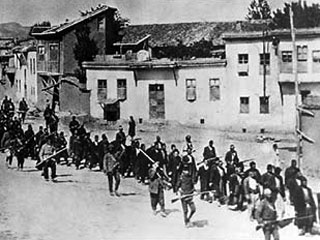
 Last two weeks the world commemorated the centennial of two events that shaped the modern history of the Turkish Republic and the Armenian people. The first event was the Battle of Gallipoli where the Ottoman Empire forces put up resistance to defend the Strait of Dardanelles stopping the European Allied forces. If Turkey had lost that war, the fate of Turkey would be very different today; a majority would speak English or French, not Turkish. The second event of the April 24th, 1915 was the Ottoman Empire’s decision to arrest and exile Armenians to the Syrian city of Aleppo. The Armenians consider the mass deportation and systematic massacre to be genocide, while the Turkish government denies that it was genocide, saying that the killings were a necessity of war. As a matter of fact, many of the major superpowers committed atrocities against others who did not agree with them or who objected to their power and, as a consequence, crushed them with bloodthirsty forces. We see some of the heads of states publish emotional statements to commemorate the victims of war. Their true motive is not about human feelings, but about still using the moment as a scapegoat or symbol for their political and personal purposes. President Obama recognized the Armenian Genocide before his election and has made it clear that his opinion has not changed; nevertheless, he refuses to use the term “genocide” as a matter of policy. He prefers to use the word “Meds Yeghern,” the Armenian word for great crime. Japan’s prime minister refuses to recognize what Japan did during the annexation of Korea and Manchuria, China in the 1930s, and Russians fail to acknowledge Stalin’s 1937 killing of millions of “socially harmful elements.” The French colonialists in Africa, as well as the Americans, Australians, and Israelis all built their countries on crimes they committed against other people. The question is whether the crimes were premeditated and systematic. Nevertheless, each nation should feel its own pain and guilt. Kurds, Turks, and Armenians should recognize mutual suffering and take a hard look at what happened to the Armenians and other minorities, accepting that Ottomans were human beings, not angels; therefore, they committed crimes and atrocities for the interests of state. A century ago state interests took a priority over human lives just as today as we see in Darfur and in the wars in Yemen, Syria, Iraq, Russia, Rwanda, and Serbia. The international community established the United Nations to prevent mass murders from happening again, but yet atrocities continue to be perpetrated; yet, the international body remains silent or refuses to label those who kill innocent people as evildoers. The problem is that today we as human beings do not accept that the devil exists, that bad people exist, and that greedy people exist just as they did in the past. It has been one hundred years since the end of the World War I and the evil events committed by the Ottoman Empire toward Armenians. That the Armenians suffered greatly cannot be denied. Thousands of innocent Armenians were uprooted from their homes, families, and land and were sent to Syria and to other parts of the Empire. Many died of hunger and exhaustion, and as they were surgically removed, the Turkish forces murdered many, raped some women, and liquidated others in a variety of ways. The Kurds, Turks, and Armenians killed each other also. For those who deny this, the best evidence is the mass graves dug by both sides, so why can they all not just accept that evil exists on both sides. The problem is that the Turkish government and some of the Turkish intellectuals continue to defend the Ottoman Empire as innocent with no culpability, never having committed any wrongdoing. This is the problem with many Muslims as well; they refuse to take responsibility for their wrongdoing and continue to play the victim’s card to sell their ideology. Another problem is that both sides play the blame game. The Turks said, “The Ottoman Empire did not kill 1.5 million and did not kill systematically because the enemies revolted against the Empire and betrayed it, so that is why the Empire forced them to death.” However, the Armenians argue that there were two million Armenians who lived under the Ottoman Empire with 1.5 million eradicated, and thus they call the events “genocide.” Turkey disputes the figure, putting the figure instead at 300, 000. Turkey claims the murders were part of a conflict not a systematic genocide or a campaign of murder and that Armenians as a group took up arms against their own group with the help of the Russians. Turkey also claims that fewer than 1.5 million Armenians actually lived under the Ottoman Empire. In the Turks’ view, Armenians sided with the Russians and betrayed the Turks while Turks were fighting against other enemies. The Turks do not deny that there were deaths but dispute the figures and the intent to eliminate the entire Armenian race. Yet, the government ordered Armenians to embark on a death march and deported Armenian families with the results mentioned above. Another narrative tells of the Ottoman’s disintegration and resulting revolts. During the last year of the Ottoman Empire, ethnic divisions became a major issue for those in charge, and Armenians were viewed suspiciously as being allied with Russia. During the Ottoman Empire non-Muslims minorities had limited control over their own affairs. In 1908, some of the junior officers, the young Turks, and the Committee for Unity and Progress gained power from the Ottoman Sultan and tried to promote Turkification. When the Ottoman Empire was at war with some of its European allies, the Russians and other allies tried to arm Armenian groups against the Ottoman Empire. The Committee of Union and Progress government decided to relocate Armenians as a measure of counter-insurgency in order to prevent the collapse of the eastern front under the enemy. This is the dark period of Armenians, Kurds, and Turks hating and killing each other. Russians supported Armenian gangsters who killed Turks or Kurds, and the Ottoman Empire rewarded each Kurd who murdered an Armenian for being loyal to Russia. On April 19, 1915, an Armenian revolt in the city of Van in Eastern Turkey brought about the deaths of thousands of Kurds, Turks, and Armenians, and the Turkish government rounded up more than 250 Armenian rebel leaders and assassinated them for betraying their country. Recently, when Pope Francis referred to the “Armenian Genocide” as one of the three massive and unprecedented tragedies of the last century, the President of Turkey, Recep Tayip Erdogan, rebuked the Pope, claiming that if both sides had a free debate to understand each other’s position, it would help the public to be more informed about what really happened and how it happened, not only on April 24th, 1915, but also before. Hrant Dink, a Turkish Armenian and an editor of an Armenian newspaper, advocated dialogues between both sides, but he was murdered in 2007. He admitted, “We are now two sick nations. The Armenians are suffering from the big traumas, the Turks from the dual personality syndrome. But who is going to heal us? Is it the French or the US Senate? Who will give a prescription and who is our doctor? The Armenians are the doctors for the Turks, and the Turks are the doctors for the Armenians. There is no other doctor or prescription apart from us.” In advocating dialogue, Dink argued that it was the only possible solution to solve the problems. The last couple of years the Turkish government has taken steps to improve the conditions of its Armenians citizens. It has restored and opened the Akhdamar Church that is on an island on Lake Van and has expanded their social and political rights to run for office and to open schools, but it is still not enough. It should return the properties of those whose parents were forced into exile, grant citizenship to those who lost their ancestors, and allow Armenian culture and history to be taught in school as well as the truth about what happened to Armenians and other minorities. Turkey should do whatever it can to pay respect to Armenians and should offer a sincere apology for what the Ottomans did to them. With their nationalist, homogenizing policies to create a perfect nation, Turks should give up on being a super nation by oppressing minorities. Turkey must come to terms with the terrible reality of April 24th, 1915 and issues an apology at least for the failure to protect evildoers. Many Turkish people do not know the truth about what happened to the Armenians for two main reasons, one because many Turks cannot read their own past historical documents since they are all written in the Ottoman language, and it was not until 1928 that the new Republic of Turkey imposed alphabetic reforms in 1928, from the Arabic alphabetic to the Latin alphabet and forbade the use of the Arabic alphabet. Second, many documents have selectively been translated into those that praise Turks and condemn the Armenians. Few scholarly materials that related to Armenian issues have been available. Historical trusts are complex and difficult to conceal but eventually reality bites back. Unhealed wounds always have bad consequences, like the Armenians’ terrorist attacks against Turkish diplomats in the early 1980s. In addition, for advocating dialogue between the two nations, Hrant Dink was murdered in 2007. In order for Turks and Armenians to make it right, they must first recognize evil exists and morally reprehensibly acts happen. Failure to understand evil leaves us ill-equipped to uproot its sources. Combined with this lack of understanding, failure to acknowledge our evil allows for evil to occur in the future. Dr. Aland Mizell is President of the MCI and a regular contributor to Mindanao Times. You may email the author at:aland_mizell2@hotmail.com
Meet the Author
Dr. Aland Mizell is with the University of Mindanao School of Social Science, President of the MCI and a regular contributor to The Kurdistan Tribune, Kurdishaspect.com, Mindanao Times and Kurdish Media.You may email the author at:aland_mizell2@hotmail.com.Categories