
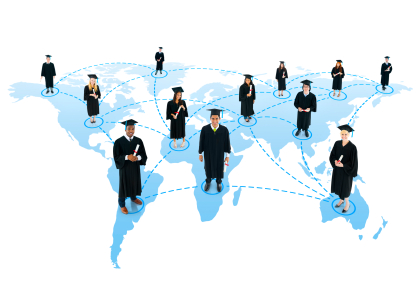
 The future of the global economy depends on the next generation, and nations that equip their youth will be competitive in the global market. We are living in a global village with fading borders. For the Philippines to meet this challenge of globalization, it is necessary to prepare its citizen for a workplace where responsibilities are constantly changing, where there is a flow of information, and where markets develop beyond the national borders. Therefore, education must help individual Filipinos to prepare for a nonlinear path, thereby levering the Philippines’ human resources for national development and international competitiveness. For example, most of the Asian countries, such as Japan, Singapore, South Korea, China, and Australia, removed restrictions that had virtually barred foreign universities from operating in these countries. To change the regulations to stimulate foreign investment in these Asian countries in general, thus giving an advantage to their economy.
The greater challenge for internationalization in the Philippines has come from this liberalization of the higher education systems in many neighboring Asian countries. The Philippine government has to recognize that a free market of ideas and economy are always good for the growth of the country. Therefore, the Philippine government should accept that globalization has created a climate for the borderless teaching and learning as well as for an expansion of opportunities for transnational education because only those who prepare their future generations can survive in the global economy. New York Times columnist Thomas Friedman in his best-selling book, The World Is Flat, recounts that he always reminds his kids to do their homework well, because the Chinese and Indians are hungry to get their jobs. Globalization has affected almost all aspects of our lives. With greater interdependence among the nations and among groups and individuals, wealth has been generated via globalization. With the advancement in information technology, a move towards knowledge-based industries, and an increase in global competition; the role of trade in services will expand. The education sector is a part of the services that cannot escape the challenges of the new global village. The Philippine government should evaluate the reasons why countries, such as the ones Friedman mentioned, considered the liberization of their educational system, so that it will increase competition and improve the quality of higher education among the local universities; it will lower the cost of overseas education; and it will avail to them a greater professionalism, such as good professors and the value of services and academic programs of excellent foreign educational institutions. Then the quality of higher education in the Philippines will further improve and make its universities internationally competitive.
Universities provide both private and public goods. The main objective of most universities is to produce knowledge through research and disseminate that knowledge through teaching. As a result, research results are available to most members of society and help stimulate economic growth. The knowledge dissemination or spread of knowledge, in addition, increases human capital, and the benefits can be direct for those who receive higher education, or indirect for those who receive the benefits from the economic increase that is attributed to the development and growth of human capital through higher education. The need for a liberalized Philippine higher education is crucial in the age of globalization, as a knowledge- based economy has become essential to compete in the global marketplace.
It is very important for the Philippine government to liberalize the country’s education system to let foreign universities open campuses in the Philippines. It is also essential to develop human capital in this country to help the private companies and the government. This development would provide an alternative for many Filipinos who seek jobs abroad that cause problems for Philippine family structures. It is true that working abroad helps solve financial needs, but it often also ruins families because kids grow up without parents, who are often overseas providing for the needs of their children. Having foreign universities in the country would be a great asset by providing a stronger international education system in the Philippines, but that will take a change in policy and in the Constitution. At the moment, the Philippines is running behind Singapore, Malaysia, South Korea, and China, because those countries have foreign universities with full campuses. In the Philippines the law includes a provision that only Filipinos can serve in the faculty as a part of the international universities. If the government changes that provision, it will attract many foreign students to study in the Philippines because the Philippines share English as the common language. International universities have a lot to offer the Philippines’ higher education by raising the quality of education, training good researchers, and improving innovation, creativity, and entrepreneurship. American and European Union based universities and colleges attract some of the world best academic and industry professionals, while employers globally value American and some Western education and training, which many universities in the Philippines lack. Only a few universities in the Philippines allow only Ph.D.-holders to teach at the school; instead, most of the universities allow Masters degree-holders to teach any subject, which may mean that they lack training, specialization, and research experiences. At present much of what a college graduate learns in school will turn out to be quite irrelevant, so that college graduates have difficulty in getting jobs for a number of reasons. Essentially, there simply are not enough job prospects in their field of specialization, or the pay rate is very low; however, a strong academic foundation is critical to the success of the next generation and to their continued competition locally and in the global workplace.
Dr. Aland Mizell is President of the MCI and a regular contributor to Mindanao Times. You may email the author at:aland_mizell2@hotmail.com