
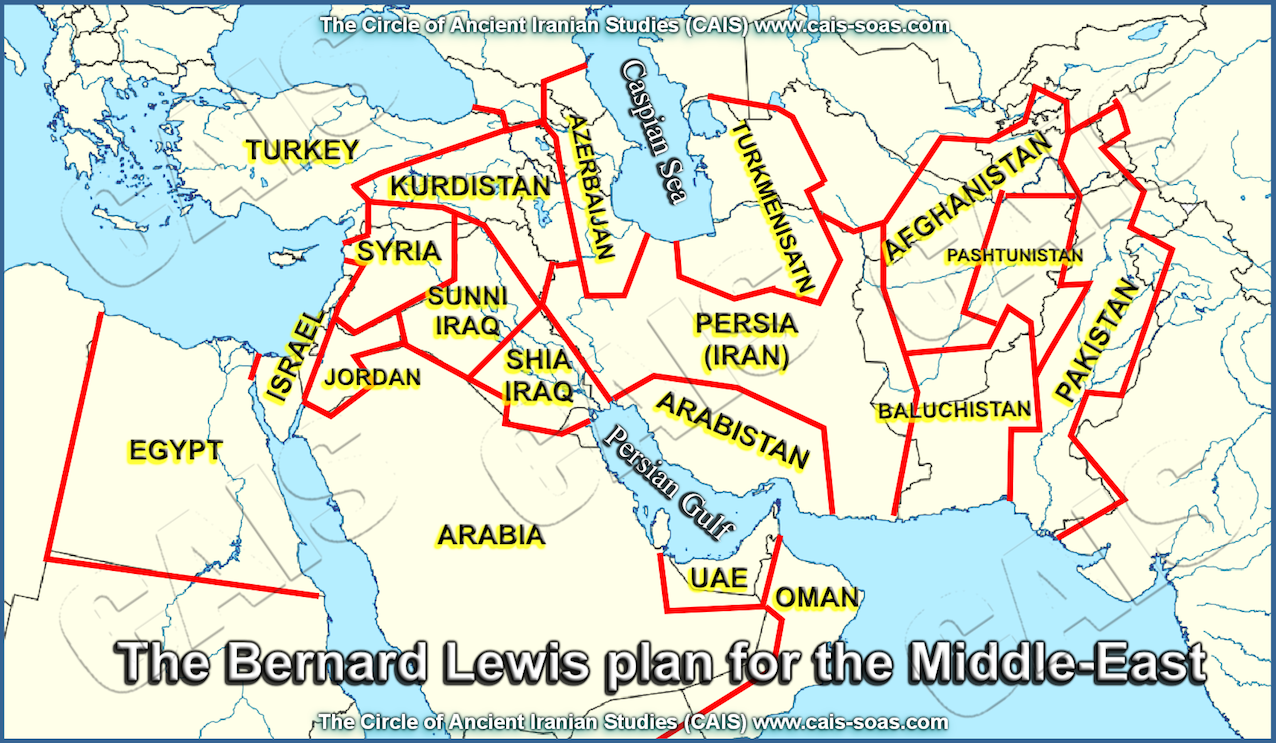
 Power in the Middle East is shifting. The new Greater Middle East map will not be drawn without Kurdistan in it. Kurdish influence in the Middle East has increased; when Kurds unite, none of the major power players can use the Kurds for their national interests anymore. Because the Arabs, Turks and Persians not only lack unity against the Kurds anymore, but also all three are fighting each other in a power struggle for the Middle East. In the past they were all united against the Kurds, but after the fall of Saddam Hussein in Iraq, the two variables of the war in Syria and the emergence of ISIS in the Middle East show that the fighting between the Sunnis and the Shias will continue.
Multiple actors juggle for power in the Middle East. The cold war between Saudi Arabia and Iran continues. Saudi Arabia and Israel already support a Kurdish independent state not because they care about the Kurds, but because they do not want Iran to advance, so they use the Kurds against Iran. The region has a lack of leadership against the ISIS. The only power now to contain the ISIS is the Kurdish Peshmerge fighters. Russia and Iran are supporting the Assad regime, and Saudi Arabia, Qatar, Kuwait and some other oil producing oil countries maintain the decline of oil price, so that the impact of this decline in the price of oil has a major economic impact on the Russian and Iranian economies. The ISIS poses a threat to all the powers in the region. The United States of America has already failed in the Middle East under the Obama administration since 2008. Iran and Russia have been able to seize power in Iraq. However, in the long run if the deal on Iran’s nuclear energy between the US and Iran is reached and an independent Palestinian state is declared, then the US will support Iran and side against other regional Sunni powers, because Iran is the minority Shia religion against the majority Sunni religious sects elsewhere. The war in Yemen led by Saudi Arabia and the unrest in Libya both threaten the interests of those who want to review their regional roles.
The Kurds are the biggest winners in the new Greater Middle East Projects. The Kurdish Autonomous Region in Northern Iraq soon will declare their independence from Iraq. That is why last month KRG President Barzani made a trip to the USA, and now the Gulf countries are all trying to get their own support for independence. This is the best chance for Kurds to gain their independence from Iraq; otherwise, they will never have another chance with as much potential as this one. The Peace and Democracy Party (BDP) and the Kurdistan Workers’ Party (PKK) in Turkey as well as the Kurdish Democratic Union (PYD) in Syria are poised to get their legitimacy to increase their power as well.
The Kurdish struggle for national liberation is one of the longest in the Middle East. The forty million Kurds are the largest ethnic group in the world without a state. In the aftermath of the First World War, the Allies divided the Kurds among four countries: Turkey, Iraq, Syria and Iran. The majority of Kurds, more than twenty million, live in Turkey. With this potential leverage, the super powers in the region have repeatedly used the Kurds as a card for their national interests. First, President Woodrow Wilson promised to give the Kurds their independent, but the Treaty of Lausanne in 1923 retracted the promise of the 1920 Treaty of Sevres and instead created the states of Turkey, Iran, Iraq, Syria with the US and other major powers ignoring the Kurds. This began the chain of America or western powers’ breaking their promise to the Kurds. But the Kurds continued to fight the oppression of the Persians, Arabs, and Turks among which their people were divided.
The major powers’ hypocrisy is just as evident today as it was after World War I. They divided Kurds into bad Kurds and good Kurds. While the United States and the EU support the Kurds in Iraq, the very same countries declare the Kurdish forces in Turkey, the PKK, to be a terrorist organization. The PKK is banned as a terrorist organization in the EU and the United States, because Turkey is a strategic ally of the US and the EU, and a member of NATO. The PKK has engaged in a long, armed struggle against the Turkish state, with more than forty thousand people being killed, imprisoned, tortured, or displaced when their Kurdish villages were destroyed. To this day the PKK is considered a terror organization, and its leader Abdullah Ocalan remains in a Turkish prison. Saddam Hussein carried out a brutal repression of the Kurds, and the US government used the Kurds’ opposition to Saddam for its own interest. Highlighting the Kurds’ oppression and Saddam’s chemical massacre of five thousand Kurds at Halabja in 1988, the West then used the Kurdish territory as a base for the invasion, but America’s long-term ally Turkey denied Americans the use of a Turkish airbase to launch it strike in 2003. Recently, however, the US government has failed to support the Kurds fully in the fight against the ISIS. As of now, the US prefers a weak and divided Kurdish nation to a unified Kurdistan. Nevertheless, only Kurds can stop ISIS in the region.
For the first time in the history of the Turkish Republic, the Kurdish HDP Party, which is the political wing of the PKK, won eighty seats in the Turkish Parliament as an independent party, thereby dramatically changing the balance of power in Parliament. In the past, Kurds ran as an independent party in the elections and then formed a parliamentary block if they had more than twenty members. At one time Kurds could not speak their language and practice their cultural rights in Turkey. For example, Leyla Zana, the first Kurdish woman in Parliament, was sentenced to ten years in prison for speaking in Kurdish, but now things have begun to change. With twenty to twenty-five percent of the vote representing the twenty million Kurds in Turkey, the Kurds have gained a not insignificant voice.
Since the Arab Spring, Kurds have become major players after previously being a card for regional and international interests. Especially the Kurdish fighters who defeated the ISIS at Kobani in Syria have inspired the Kurds in Turkey and brought out their nationalism in a desire to unite in order to gain more rights from their oppressors. An indication of this rise in Kurdish power is seen in that Turkey has a electoral law called the “Electoral threshold,” which means any political party must get ten percent of the total votes in order to enter the Parliament. The secular army imposed this law after the coup of 1980 to prevent Kurds and Islamic groups from entering Parliament. However, some of the Islamic parties managed to bypass the law and entered Parliament before the Justice and Development Party’s (AKP) great success. Of course, this law is not good for the small parties, because small parties either have to ally with the major parties to win or run as an independent party. HDP party a pro Kurdish party, had twenty-seven members in Parliament before the recent elections, but now it passed the electoral threshold by gaining eighty seats, making it a key political force in Turkey and changing the balance of power in the Turkish Parliament.
However, such a victory is a big loss for the current ruling AKP, which had 312 seats in the Parliament but now has 258 seats. The AKP secured less that forty-one percent of the vote. This loss occurred because some of the Kurdish religious votes went to the Kurdish Democratic HDP party this time, whereas in the past, the AKP party had complete influence in the Kurdish region especially among the conservative Kurds. The other Turkish parties do not have any influence in the Kurdish region. The Kurdish Party’s victory was a big loss for President Recep Tayyp Erdogan’s campaign to switch Turkey from a parliamentary system to a presidential one. The AKP had hoped for a supermajority to force through the constitutional change. The Kurdish party, the Republican Peoples’ Party, and the National Movement Party rejected the presidential system because they fear the presidential system would give Erdogan more power. For Erdogan to win, he needed at least two-thirds of the seats or 367 seats, but he and the AKP lost its majority in last Sunday’s election. As the biggest party in Turkey, the AKP had controlled Turkey’s Parliament since 2002. The question is why did the AKP lose this election? It had hoped to secure votes from the traditional Muslims because of the record of economic prosperity under its rule for thirteen years. Also, for decades, Kurdish identity was suppressed by the Turkish state. Under the AKP, and probably in part due to pressure from the EU, Kurds began to experience more cultural rights, including freedom of speech and the freedom to write in their own language, but now it is impossible to ignore the effect of Kurdish politics. Despite years of obstacles and difficulties, the Kurds have finally established a lasting legacy on the Turkish national stage. The AKP had also hoped to run on its transformation of Turkey with reforms that have created a new middle class. The AKP helped bring prosperity and stability. For example, Turkey is the only country in the Middle East that does not have a war despite being next door to Iraq and Syria that are both in wars. The AKP also lifted decades of secularist suppression of Turkey’s devout Muslims; for example, the headscarf was banned in Turkey, but under the AKP the ban was removed, and other reforms enacted that opponents say indicate the conservative Muslims’ move to gain control over private lives as well as public ones.
As President, Erdogan was able to enact major changes even though Turkey is currently a republic. The office of the presidency in Turkey is largely a ceremonial post, but Erdogan did not want to be a passive president but wanted, instead, to have a strong presidency. Opponents criticized him for this grappling for power, but actually a presidential system would be good for the Kurds because it would give more power to local politics and lead the Kurds to have their autonomy. Based on his trajectory, Kurds feared Erdogan might have a strong central government. The problem with the Kurds before and even now, however, is that they have not been unified because of their tribal system; each tribe always struggles for power, so that they fight among themselves and yield themselves to the influence of super powers. But today the tribal impact has waned among Kurds, especially in Turkey, although in Northern Iraq the dominant Barzani and Talabani tribes still remain loyal to their group. Turkey replaced tribes with guerilla groups or groups based on religion or politics, like the PKK and Hezbollah. Each tribe had a chief, and in general chiefs did not like each other. Consequently, this societal structure and thus disunity is the main reason that Kurds do not have a state. The present offers, however, a new Kurdish reality, so that political and diplomatic struggles may replace the military ones.
Although the AKP said they represented the Kurds in Turkey and thus were the Kurdish party, after this election the AKP may no longer consider themselves as the Kurdish party. The reason the Kurds did not support the PKK and the Kurdish party before is because the PKK was more secular and leftist with a Stalinist ideology, and the majority of Kurds are very religion, even if other Muslims were oppressing them. The Kurds did not approve of racism, because theoretically Islam strongly rejects racism, and also they did not want to support the leftist ideology, but the Kurdish HDP has changed to become more inclusive. If we compare the Kurds to the Muslim factions in the Philippines, the PKK would be like the MNLF, and Hezbollah would be more like MILF.
When the ISIS attacked the Kurds in the Syrian city of Kobani, the Turkish government did not support the Peshmerger, and this made many Kurds upset, so that even if they did not support the PKK before, they started to sympathize with them because it became a matter of national pride. The Kurds felt they were being humiliated. Many religious Kurds did not support the Kurdish political party before or the armed wing of the PKK, but the ISiS war on Rojava Kurds and Kobani united the Kurds. Not only did the Turkish government not help the Kurds in Kobani, but it also prevented Kurds in Turkey from leaving to fight against ISIS for their brothers in the Syria, and this led to the death of many Kurds in Kobani. This election was a victory for Kurds who want to rule themselves, not be strangers in their homeland, and take control of their land.
A final factor shaping the outcome of the election is an ongoing war on a Muslim cult called the Gulen movement that wanted to stage a coup in Turkey to rule Turkey based on Gulen’s ideology and views on Islam. Even though the Gulen organization does not like the Kurds, for this election they united with the Kurds against Erdogan because Erdogan is going after them.
The consequence of the elections in Turkey are worth watching because by transforming the political actors in that country, the Kurds in particular and the Middle East in general have clear opportunities to achieve their goals in this historical moment.
Dr. Aland Mizell is President of the MCI and a regular contributor to Mindanao Times. You may email the author at:aland_mizell2@hotmail.com