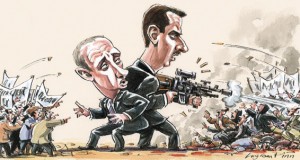
 The War in Syria is getting out of hand. Russia’s militarily involvement in the Syrians’ war in the name of fighting the ISIS has changed the new balance of power in the conflict. The U.S government has failed to achieve its objectives in Syria. Until recently the Obama administration pursued a policy of degrading, restraining, and containing, but not seriously defeating the ISIS. According to some reports, Syria might have large deposits of natural gas off its coastline and in its Economic Exclusive Zone, the adjacent territorial marine area next to a seaward edge. If this is true, then this is another reason that Russia is trying to bolster Assad and to make sure that in a post-Assad regime Alawites participate in whatever government eventually emerges in Syria, so that Russia can expand its naval and air base. Russia is a primary natural gas supplier to European countries, and, as such, would like to protect its sale of natural gas to the EU and to limit the EU countries’ access to other sources.
Russian involvement in Syria took place during a period of a paradigm shift in the international system. Turkey is trying to overthrow Assad while Russia is trying to keep him in power. Now Russia is taking the lead in the war in Syria. Further, Putin‘s actions in Syria are making President Obama look weak at best in a period of post unipolarism in which the U.S. has lost power in the global arena. Especially under the Obama administration the U.S.’s Middle East policy has proved bankrupt. In addition, the absence of the any contender to the U.S. hegemony in global politics has caused a rise of more geographically-situated challengers to its dominance.
China began to challenge the regional system that was present in the South China Sea by constructing air bases. The Chinese government continues to show a strengthening military as an option by increasing the visibility of its military might.
Russia’s involvement in the Syrian War demonstrates its power to international world politics and systems. Russian President Vladimir Putin is trying to bring the spirit of the Soviet power back. In one of his speeches he called the collapse of the Soviet Union the biggest geopolitical catastrophe of the world. Based on this philosophy, Putin used the Russian military power to challenge international norms and to change the balance of power related to geopolitics. For example, Russia sent its military to Georgia in 2008, in the crisis in the South Ossetia and Abkhazia, in part because Russia did not want Georgia to become a member of NATO. In 2014, Russia invaded Ukraine and annexed Crimea to Russia, in reaction to the possibility of the European Union-Ukraine Association Agreement with Ukraine. Russia has used its card very well so far and has emerged the winner of the new global world order. Russia used the Ukrainian conflict to strengthen its control on its western borders by annexing Crimea to prepare the ground at home for a more aggressive and expansionist political movement. Russia is now using the ISIS as an excuse to fight against the terrorists while, in fact, supporting the Assad regime and bombing moderate Syrian opposition groups.
Actually, in Syria there are now two evil groups; one is the Assad regime and the other one is the ISIS. The question is how will the U.S., the E.U. countries, the Gulf countries, and Turkey respond to the Russia’s aggressive attempts to balance the power? Will the Russian military involvement in Syria change the course of the civil war? Russia shares a border with Syria, so why is it so interested in Syria now? Russia took advantage of failed states in the Middle East and of a lack of strategic planning and strong leadership to deal with Syria and Ukraine. Now Russia and Iran are using the ISIS as an excuse to establish a new balance of power and to help the Assad regime, an alliance that might cause anti-Russian sentiment in the Middle East and the Arab world because Russian involvement in the war in Syria fuels more extremism and radicalization as well as helps the Assad regime to prop up its power base to remain in power for long time by increasing attacks on the moderates. Now it is important to empower the moderate Syrian groups, to get rid of the Assad regime, to destroy the ISIS, and to begin a new process of democratic, inclusive transition, including the Kurdish political groups in Syria.
The Turkish government has strongly disapproved of Russia’s involvement in the war in Syria. Recently, Russian MIG fighters entered Turkish airspace. Turkish President Erdogan said that Russia has more to lose than Turkey because Turkey contracted with Russia to build a Russian-designed nuclear power plant, the Akkuyu plant in Mersin. The Turks have already spent $ 3 billion on this plant. If necessary other countries can complete this plant. Turkey is one of Russia’s main natural gas customers, but if Putin closes the valves, Turkey can buy gas from other places while Russia will be denied major revenues. If Russia succeeds in defeating the ISIS, it will strengthen the Assad regime and will put Turkey in a difficult position, because if Moscow gets rid of the ISIS, it will help the Kurds in Syria to have an autonomous region in Syria. Russia wants recognition, respect, and influence. In the case of Syria, Russia’s specific intentions relate to Russian interests, as is the case of interests of other major powers. Russia argues the West is its paramount concern since the West is always looking out for its own people and their security. Russian involvement in the war in Syria will not make the situation better, but only worse.
It is true that Russia is the winner in this game, but upon entering open military conflict with the fundamentals, Russia has forgotten that a local branch of the Islamic State exists on its own territory in the form of a network of radical Islamic groups in the North Caucasus and Volga regions. The recent maneuvering of Russian troops in Syria is a result of Putin’s nostalgia for the Soviet past when the Soviet Union was mighty and powerful; therefore, Putin is trying to show the world that Russia can and does have the same power in the region at present.
Dr. Aland Mizell is President of the MCI and a regular contributor to Mindanao Times. You may email the author at:aland_mizell2@hotmail.com